
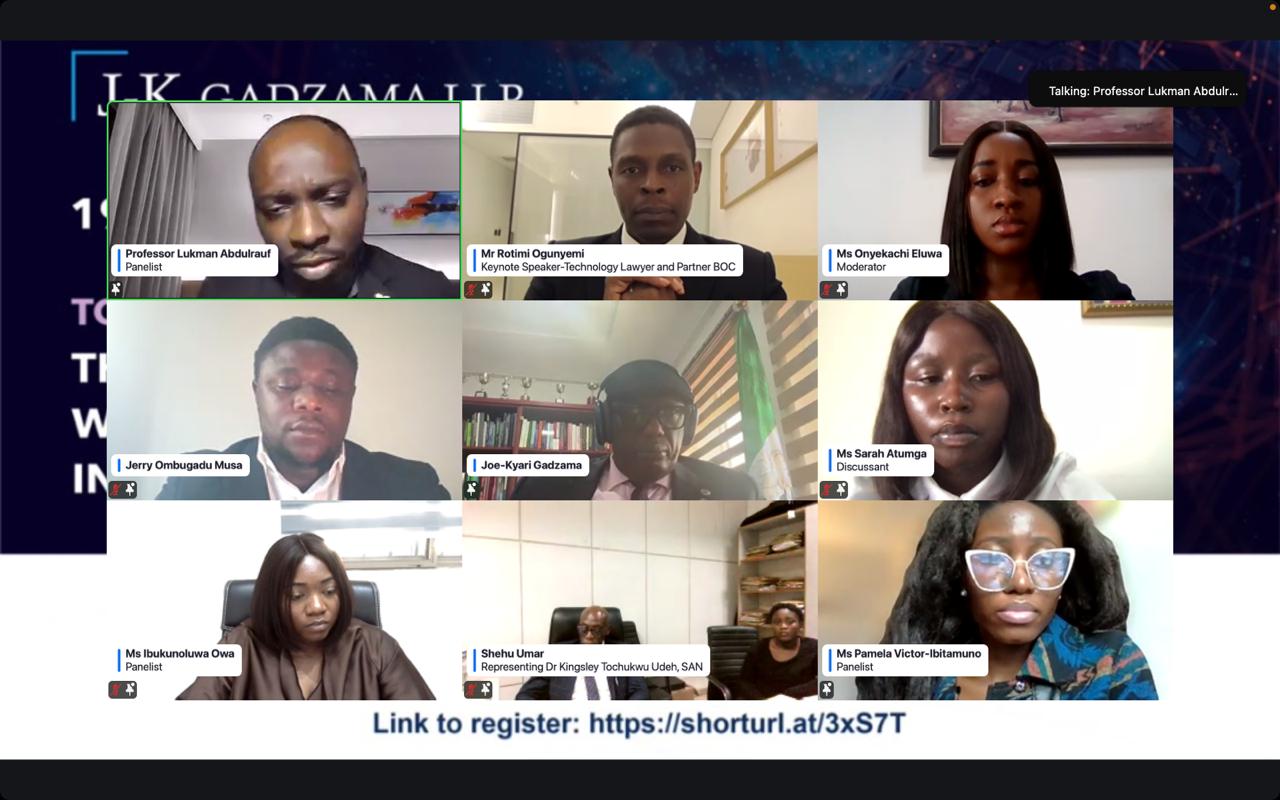
Leading legal practitioners, academics, regulators, executives, industrialists and technology experts have called for increased AI literacy, stronger worker protection and effective human oversight of automated systems as Nigeria prepares for the changing nature of work.
They spoke at J-K Gadzama LLP’s 19th Annual Public Lecture held virtually on Wednesday, 11th November 2026, under the theme “The Future of Work: Preparing Nigeria’s Workforce for the Age of Artificial Intelligence.” The programme examined AI’s implications for employment, professional competence, data protection, productivity, cybersecurity and regulatory accountability.
Dignitaries at the Lecture included the Minister of Innovation, Science and Technology, Dr. Kingsley Tochukwu Udeh, SAN who was represented, serving and retired Judges, Senior Advocates of Nigeria, top Executives and Business Owners. Among the Senior Advocates were Prof. Peter Terkaa Akper, SAN, OFR and Prof. Paul O. Idornigie, SAN who both made contributions to the discussion.
In his welcome address, Chief Joe-Kyari Gadzama, SAN, Life Bencher and Founding Principal Partner of J-K Gadzama LLP, emphasised preparing Nigerians, especially young professionals, for a technology-driven economy. He called for sustained investment in digital literacy and skill development, and for collaboration among government, industry, academia and the legal profession.
The Chairman’s opening remarks were delivered by Mr. Umar Shehu Bida, Legal Adviser to NOTAP, on Udeh’s behalf. The Minister called for AI literacy in mainstream education and professional training, including the ability to evaluate AI-generated information, identify bias and protect confidential data. He also said technology transfer should be judged by the local expertise and sustainable capacity it develops.
In the keynote lecture, Mr. Rotimi Ogunyemi, a seasoned technology lawyer and Partner at BOC Legal, urged employers to embrace AI responsibly while prioritising employees. He recommended starting with specific workplace tasks, consulting directly affected employees and providing structured training during working hours. He cautioned against treating AI output as inherently accurate or measuring productivity without accounting for verification and correction time. He also emphasised preserving supervised professional practice and extending AI training to the informal economy.
Ogunyemi stated in the brief accompanying his keynote paper: “Nigeria should judge its preparation for artificial intelligence by the work people can demonstrate, the opportunities through which they earn and the correction available when systems affect their rights.”
The panel examined practical, economic and regulatory issues. Professor Lukman Abdulrauf of the University of Ilorin raised concerns about AI-driven efficiency, employment and income distribution, using the example of five AI-assisted lawyers performing work previously done by ten. He called for empirical research on AI adoption in Nigeria, especially in the informal economy.
Ibukunoluwa Owa of the Nigeria Data Protection Commission urged privacy risk assessments before deploying AI systems that process personal data, controlled testing environments, clear policies on employee use of AI platforms and accessible human review of automated decisions.
Folahanmi Ogunbodede, a UK-based systems and cybersecurity expert, stressed assessing operational risks and business needs before AI adoption, and recommended cybersecurity policies, monitoring and periodic audits. He also identified opportunities for young lawyers in AI governance, cybersecurity compliance and data protection.
Pamela Victor-Ibitamuno, a Cybersecurity Governance, Risk and Compliance Analyst at CybariK, UK, used the example of mathematician Katherine Johnson to stress independent verification of automated results. She warned that AI-generated legal documents may contain inaccurate references or citations to non-existent cases, and that qualified professionals must remain accountable.
Sarah Jeta Atumga, Esq., a Senior Associate at J-K Gadzama LLP, examined workers’ rights, responsibilities and readiness. She illustrated the need for practical AI competence through a garment maker whose AI-generated quotation could underestimate production costs. She advocated safeguards against discriminatory AI-assisted recruitment and appraisal systems, and oral assessments and supervised practical exercises to preserve independent professional judgment.
In closing, Gadzama raised questions about which institutions should oversee AI compliance in Nigeria, their regulatory capacity and how breaches should be addressed.
The organising committee undertook to prepare a communiqué for participants, relevant institutions and the National Assembly.
(C) CITY LAWYER Magazine. All rights reserved. To join our Channel, click here. Click here to join our WhatsApp chatroom. Contact us at citylawyermag@gmail.com or 081-3838-0083.
Leave a Reply
You must be logged in to post a comment.