
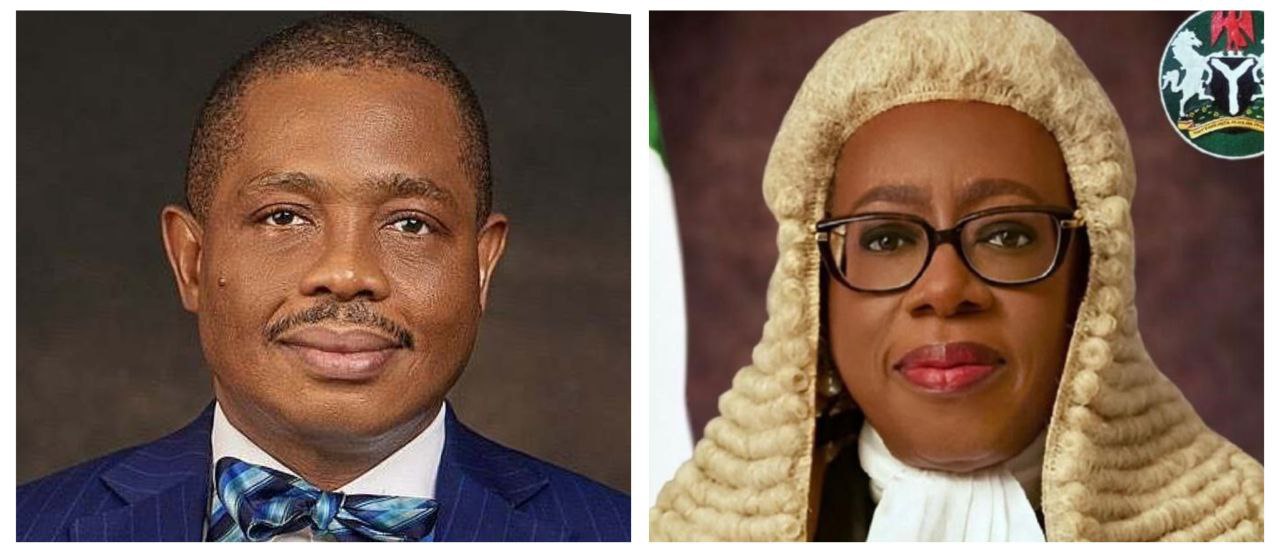
Contrary to reports suggesting that the President of the Nigerian Bar Association (NBA), Mazi Afam Osigwe, SAN, described judges and lawyers as the “worst bribe takers and givers,” a review of the full text of his speech shows that no such assertion was made.
Excerpts from the address reveal that Osigwe neither labelled judges as the “worst bribe takers” nor lawyers as the “worst bribe givers.” Rather, he delivered a measured, data-driven call for reforms aimed at strengthening the integrity and credibility of Nigeria’s justice system.
Osigwe spoke on February 6, 2026, on the theme “Judicial Corruption in Nigeria: A Menace to Democracy and Social Justice,” where he addressed corruption as a systemic challenge affecting democratic governance, public confidence and social justice.
At the outset, the NBA President acknowledged prevailing public perceptions of the justice system, stating that, “Many Nigerians have steadily lost confidence in the judicial system as it has been widely perceived as being riddled with corruption, inconsistency, and undue influence.”
He noted that this perception has grave consequences, adding that, “The judiciary, which ought to be the last hope of the common person, is increasingly seen as an arena where justice can be delayed, manipulated, or outrightly purchased by the highest bidder.”
However, Osigwe was careful to explain that corruption is neither peculiar to the judiciary nor the failing of a single professional group. He described corruption as a broader societal malaise, citing international authorities such as the United Nations Convention against Corruption (UNCAC) and the World Bank.
Quoting UNCAC, he said corruption is an “insidious plague” that “undermines democracy and the rule of law, leads to violations of human rights, distorts markets and erodes the quality of life.”
In addressing the justice sector, Osigwe relied on empirical data rather than personal accusations. He cited a 2018–2020 survey by the Independent Corrupt Practices and Other Related Offences Commission (ICPC), which estimated that about ₦9.4 billion was paid as bribes within the justice sector, with lawyers accounting for the highest proportion of bribe-givers.
He also referenced a 2024 joint survey by the United Nations Office on Drugs and Crime (UNODC) and the National Bureau of Statistics (NBS), which estimated that Nigerian public officials received about ₦721 billion in cash bribes in 2023, with judges listed among several affected public officials.
Osigwe, however, placed the statistics in context, warning against simplistic conclusions. Adopting the views of Tayo Oyetibo, SAN, he stated: “It takes two to tango. Where there is no ‘offeror’ there can be no ‘offeree’. In other words, corruption persists because there are corruptors and corruptees.”
He explained that corruption thrives not only because of compromised public officials, but also because citizens, lawyers and litigants sometimes seek to influence outcomes through inducement.
The NBA President also recalled earlier admissions within the profession to show that the issue is neither new nor concealed. He cited a 2012 statement by former NBA President, J.B. Daudu, SAN, who openly acknowledged corruption within the justice sector.
Quoting Daudu, Osigwe recalled: “I make no distinction here between the Bar and the Bench. Corruption is now a live issue that is threatening to tear apart the foundations and fabric of society.”
According to Osigwe, such past admissions demonstrate that the legal profession has long recognised the problem and must confront it with honesty and reform, rather than denial or sensationalism.
He further noted that public perception, even when exaggerated, can be as damaging as proven misconduct. Referring to remarks by the Sultan of Sokoto, he said: “Today, justice is increasingly becoming a purchasable commodity, and the poor are becoming victims of this kind of justice, while the rich commit all manner of crime and walk the streets scot-free.”
Osigwe said such perceptions reinforce distrust and inequality, stressing that restoring confidence requires deliberate institutional action.
Far from attacking the judiciary, the NBA President commended the Chief Justice of Nigeria (CJN), Justice Kudirat Kekere-Ekun, for her reform-driven posture. He quoted her admonition to judges: “Let your judgments be reasoned, impartial and courageous. The Judiciary, as the final arbiter of justice, depends on the credibility of its officers.”
He also acknowledged the role of the National Judicial Council (NJC) in disciplining erring judges, noting that suspensions, dismissals and compulsory retirements have followed proven misconduct.
Osigwe warned that judicial corruption undermines democracy, stating that “when courts become instruments for shielding the corrupt or punishing political opponents, elections lose meaning, governance becomes arbitrary, and the social contract fractures.”
He concluded by stressing that the fight against judicial corruption is a collective responsibility of judges, lawyers, institutions and citizens alike, declaring: “History will judge us not by our eloquence, but by our willingness to act.”
(C) CITY LAWYER Magazine. All rights reserved. To join our Channel, click here. Click here to join our WhatsApp chatroom. Contact us at citylawyermag@gmail.com or 081-3838-0083.