
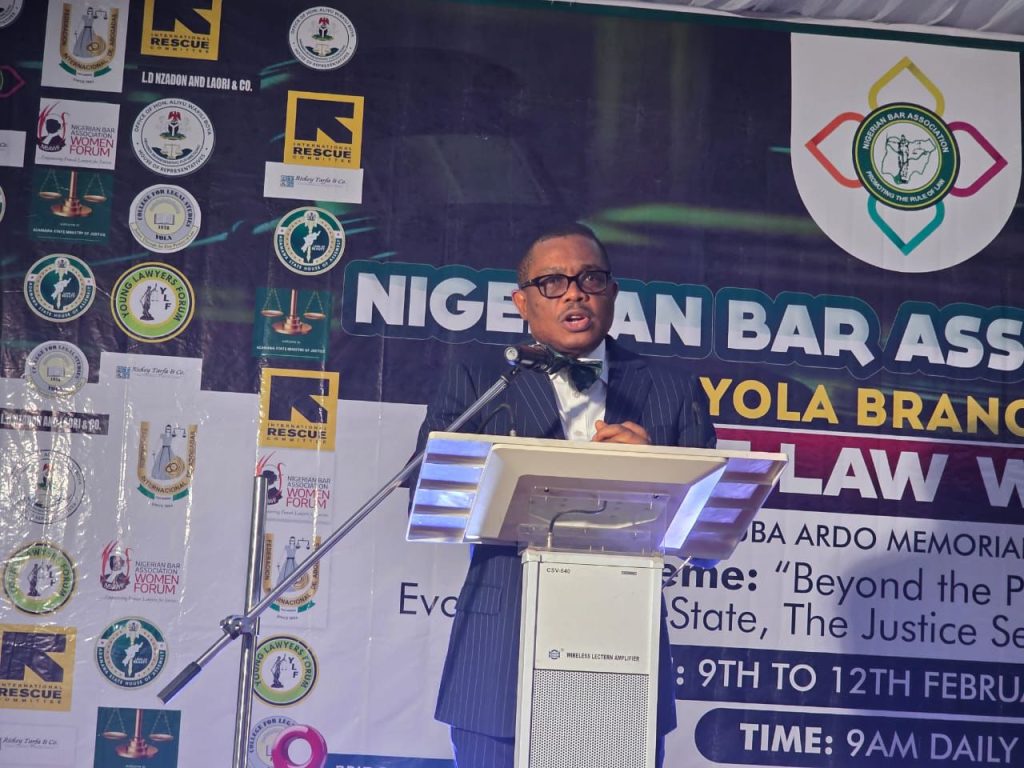
The President of the Nigerian Bar Association, Afam Osigwe, SAN, has called on legal practitioners to embrace innovation, invoking the timeless wisdom of Lord Denning in Parker v. Parker, that the law would remain stagnant if we refuse to act simply because something has never been done before.
He stressed that continuous professional development is no longer optional but essential for the growth, competence, and relevance of lawyers in a rapidly changing world.
The event was the opening ceremony of the NBA Yola Branch Law Week, held in Yola, Adamawa State, with the theme “Beyond the Present: Evolution of a State, the Justice Sector and Lawyers.”
Delivering his keynote message, the NBA President took participants on a reflective journey through the evolution of legal practice, reminding lawyers that change has always been a constant feature of the profession. He recalled a time when it was considered fashionable for lawyers to merely own land lines, long before the era of smartphones, and when fax machines were the height of technological advancement.
He also narrated how banking and legal transactions were once constrained by geography, noting that presenting a cheque for an account domiciled in Yola often required travelling long distances. These realities, he said, underscored how far society and professional practice have evolved.
According to him, as societies change, the practice of law must also change. He posed a critical question to the audience: how ready are we, as lawyers and as a justice system, for inevitable change? He warned that comfort with the present, without a deliberate effort to innovate, often leads to professional stagnation and eventual irrelevance.
Emphasising the need for institutional reform, the NBA President stressed that the judiciary must innovate and fully embrace technology, particularly through the adoption of e-filing systems and other digital processes. He illustrated this point with the story of Nokia, once a dominant force in the global mobile phone industry, which lost relevance as technology advanced.
While Nokia’s leadership reportedly believed they had done nothing wrong, he observed that their failure lay in the inability to innovate in response to changing times. In contrast, the entry of the iPhone into the market redefined the industry and displaced former leaders.
Drawing parallels with legal practice, he highlighted the shift from hardcopy law reports to online law reporting systems as a clear example of how the profession has evolved. Lawyers, he said, must consciously align with these changes to remain relevant and effective.
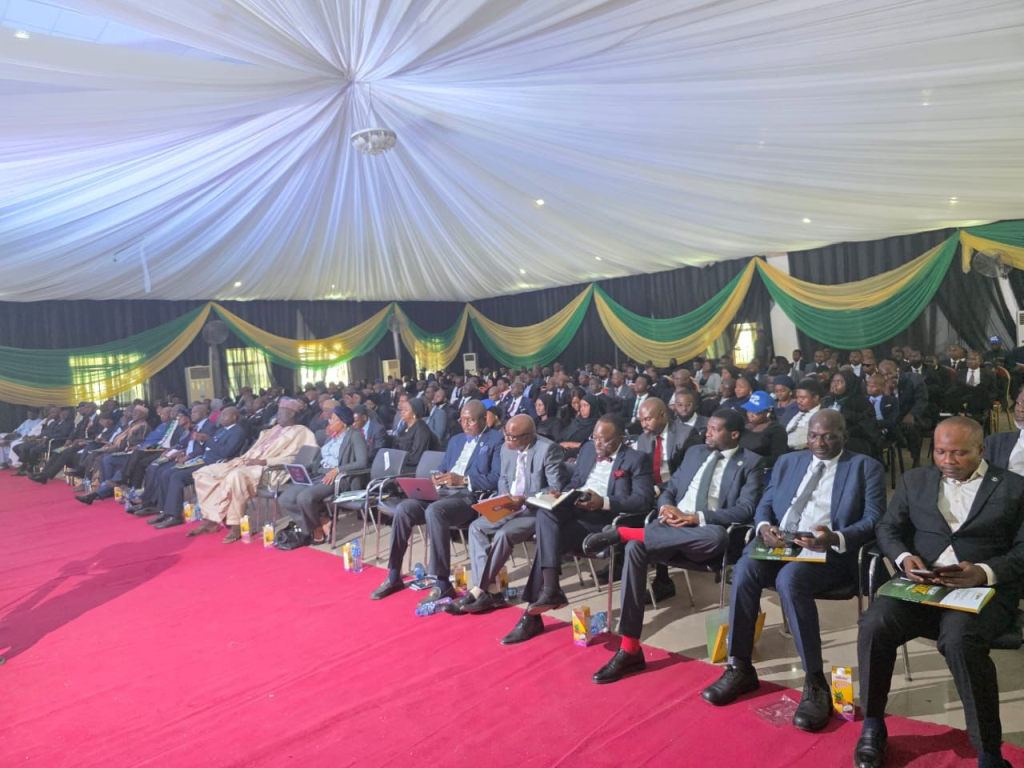
In a literary illustration, he referenced the character of Unoka in Things Fall Apart by Chinua Achebe, who farmed on tired and exhausted land and consequently reaped poor harvests. The lesson, he explained, is that lawyers who operate perpetually within their comfort zones, without adapting to new realities, should not be surprised when their results fall short. He warned that when a justice system delivers judgments that fail to reflect contemporary social realities, it creates serious challenges for society and undermines public confidence in the legal system.
The President expressed optimism that Nigeria could achieve meaningful evolution and progress if the justice system is restructured to save time and resources. He advocated for wider use of virtual hearings, effective case scheduling, and e-filing, while also emphasising the need for deliberate investment in the infrastructure and facilities required to support these innovations.
According to him, embracing these reforms would significantly enhance the quality of legal practice in Nigeria. He also urged lawyers to continually improve themselves and to comply strictly with the Legal Practitioners’ Remuneration Order, warning against the culture of undercharging for professional services, which he described as harmful to the dignity and sustainability of the profession.
Beyond technology, the NBA President stressed the importance of consistency and predictability in judicial decisions. He noted that conflicting judgments from courts undermine confidence in the justice system and make it difficult for lawyers to properly advise their clients, particularly in politically sensitive cases. An evolving judiciary, he said, must ensure that its decisions are coherent, predictable, and anchored in sound legal reasoning.
He cautioned that if lawyers and judges undermine the profession through complacency or internal decay, there would be no profession left to defend. Instead, he called for a collective commitment to building a vibrant, respected legal profession that commands pride of place in society, wherever its members may be found.
In his concluding remarks, the NBA President reiterated that the world is changing rapidly and that the legal profession must consciously adapt to these changes. Beyond the present, he said, lies the responsibility to plan for the future. Mere rhetoric about international best practices is not enough; such practices must be institutionalised if the justice system is to truly work for the people.
He congratulated the leadership and members of the NBA Yola Branch on the successful commencement of their Law Week and expressed confidence that the conversations and deliberations would contribute meaningfully to the advancement of the legal profession in Nigeria.
(C) CITY LAWYER Magazine. All rights reserved. To join our Channel, click here. Click here to join our WhatsApp chatroom. Contact us at citylawyermag@gmail.com or 081-3838-0083.