
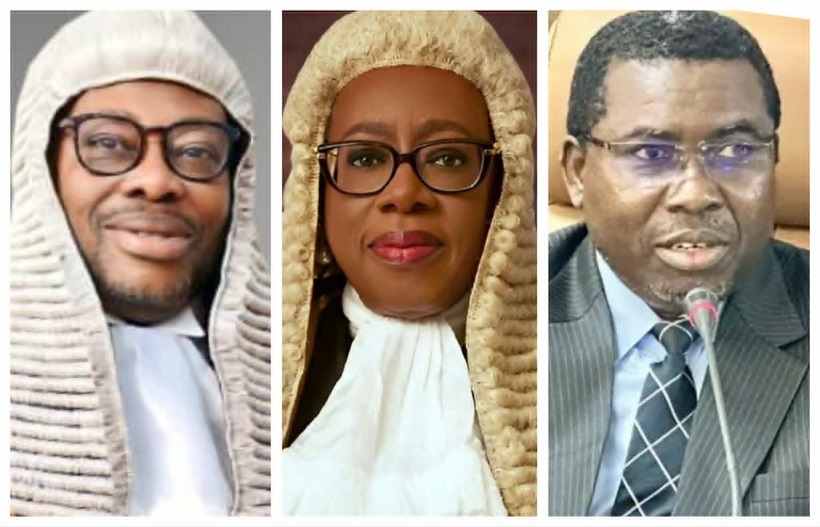
Are We at a Judicial Crossroads with the Decisions of Justices Umar and Omotosho on INEC’s Electoral Guidelines?
The two decisions of the Federal High Court delivered respectively by Justice Mohammed G. Umar and Justice James Kolawole Omotosho are already generating intense constitutional and electoral discourse within legal circles.
Both judgments dealt with the legality of the Independent National Electoral Commission (INEC)’s administrative timetable and guidelines issued for the 2027 general elections vis-à-vis the provisions of the Electoral Act 2026. Although both courts addressed substantially similar legal questions, they arrived at partially convergent and partially divergent conclusions. This has now sparked debate among senior members of the Bar on whether Justice Omotosho ought to be reprimanded for allegedly delivering a judgment inconsistent with that of Justice Umar.
This article examines the two judgments, identifies their points of agreement and disagreement, and evaluates whether the controversy over judicial contradiction is legally sustainable or merely academic sensationalism.
Justice Mohammed Umar, in the suit filed by the Youth Party, invalidated substantial portions of INEC’s revised timetable for the 2027 elections. The court held that INEC exceeded its powers by prescribing timelines that abridged periods expressly guaranteed under the Electoral Act 2026.
On the other hand, Justice James Omotosho, in a separate suit instituted by the Social Democratic Party (SDP), upheld INEC’s constitutional and statutory authority to issue election timetables and prescribe timelines for political activities, although he equally struck down portions of the timetable that directly conflicted with express statutory provisions.
Thus, while the media portrayed the judgments as contradictory, a closer legal examination reveals a more nuanced reality.
The truth is that both courts affirmed the supremacy of the Electoral Act over INEC’s timetable and guidelines. This remains the strongest common denominator in the decisions of the two judges.
Justice Umar held unequivocally that INEC cannot abridge statutory timelines created by Section 29(1) of the Electoral Act through administrative directives. Justice Omotosho similarly ruled that INEC cannot lawfully compress or override timelines expressly fixed by the Electoral Act. He specifically invalidated portions of INEC’s timetable that conflicted with the statutory 120-day period for submission of candidates’ particulars.
Accordingly, both courts accepted the settled principle that administrative regulations derive their legitimacy from the parent statute and cannot supersede or contradict statutory provisions. This principle is deeply rooted in Nigerian administrative law and constitutional jurisprudence.
Again, both courts recognised INEC’s regulatory role. Contrary to public perception, Justice Umar did not totally strip INEC of regulatory powers. His concern was primarily with timelines that abridged statutory rights vested by the Act.
Justice Omotosho was more explicit in affirming INEC’s authority under the Constitution and the Electoral Act to organise, coordinate, and regulate the electoral process. In other words, neither judgment denied that INEC possesses administrative and supervisory powers over elections.
However, their point of disagreement lies in the extent of those powers and the manner in which they may be exercised by INEC.
It is also important to note that both courts invalidated portions of the INEC timetable. This significant point has largely been ignored in public commentary.
While Justice Umar invalidated broader portions of the timetable touching on: party primaries, candidate nomination, substitution, campaign timelines, and publication of the final list of candidates, Justice Omotosho nullified deadlines relating to nomination submissions because they violated Section 29(1) of the Electoral Act.
Therefore, both judges agreed that INEC crossed statutory boundaries in certain respects in the exercise of its administrative powers.
It is now necessary to examine the areas of significant divergence between the two learned Justices.
Justice Umar held that INEC lacks the authority to prescribe timelines within which political parties must conduct primaries. According to him, Sections 82 and 84(1) merely empower INEC to receive notices and monitor primaries, not dictate when they should hold. Justice Omotosho disagreed.
He held that election timetables necessarily include timelines for party primaries and other preparatory electoral activities. In his candid view, INEC’s constitutional responsibility to organise elections would become practically impossible if it lacked authority to structure the electoral calendar.
This disagreement is essentially interpretative, as posited by Prof. Ernest Ojukwu, SAN.
Justice Umar adopted a narrow construction of INEC’s powers, while Justice Omotosho adopted a broader interpretation.
Another issue of disagreement concerns the party membership register.
Justice Umar invalidated the May 10 deadline for submission of membership registers and effectively extended the permissible period until September 2026.
Justice Omotosho, however, upheld INEC’s authority to request membership registers and prescribe timelines for their submission, provided such timelines do not conflict with express statutory provisions.
This divergence is critical. Justice Omotosho viewed the membership register issue as an administrative necessity ancillary to election management, whereas Justice Umar saw it as an unlawful restriction on political participation and party mobility. To Justice Umar, the May 10 deadline would negatively impact rights already granted to political parties and their candidates, rights which statutorily endure until September.
On the breadth of the reliefs granted, Justice Umar’s orders were sweeping and omnibus in nature. He broadly invalidated several interconnected aspects of the timetable. Justice Omotosho, on the other hand, adopted a more restrained approach. Rather than dismantling the timetable framework, he surgically removed only those provisions directly inconsistent with the Electoral Act.
These two judgments reflect two distinct judicial philosophies. Justice Umar emphasised strict statutory fidelity, while Justice Omotosho emphasised institutional practicality and electoral functionality. Such divergence is permissible within judicial jurisprudence.
The next issue is whether Justice Omotosho should be criticised or sanctioned for delivering a judgment allegedly inconsistent with that of Justice Umar despite being aware of the earlier decision.
With respect, that argument appears overstated. Courts of coordinate jurisdiction can reach different conclusions. Both judges sit as judges of the Federal High Court, which is a court of coordinate jurisdiction. Under Nigerian law, the decision of one Federal High Court judge is persuasive, not binding, on another judge of the same court.
A judge may respectfully disagree with another judge’s reasoning where: the facts are different, the reliefs sought differ, the issues are differently framed, or the law admits of differing interpretations.
It may therefore be difficult to categorise such divergence as judicial misconduct. In truth, it forms part of the natural development of legal jurisprudence.
Indeed, Justice Omotosho did not entirely reject Justice Umar’s reasoning. In fact, he agreed with Umar on the supremacy of the Electoral Act over INEC guidelines.
Their principal divergence concerned the scope of INEC’s administrative authority. Accordingly, describing the judgments as “contradictory” oversimplifies the jurisprudential nuances involved.
The beauty of common law adjudication lies partly in competing interpretations that are eventually harmonised by appellate courts. The proper constitutional mechanism for resolving conflicting interpretations is appeal, not reprimand.
Nonetheless, one can understand the public outrage surrounding Justice Omotosho’s judgment. Much has been written and said against conflicting judgments, forum shopping, and abuse of ex parte orders. However, it remains debatable whether this decision falls squarely within the category of condemnable judicial misconduct commonly criticised in our legal system.
Indeed, INEC has already appealed Justice Umar’s decision. That remains the lawful pathway. The decision of Justice Omotosho should likewise be appealed, and ideally both appeals should be consolidated before the same appellate panel in order to provide clarity on the divergence in the positions of the two Justices.
The real issue raised by both judgments goes deeper than judicial disagreement. The central constitutional question is this: How far can INEC go in regulating elections without trespassing into legislative territory? That question sits at the intersection of: constitutional democracy, electoral certainty, party autonomy, and administrative necessity.
Justice Umar leaned toward the protection of statutory rights and political flexibility, while Justice Omotosho leaned toward preserving electoral order and administrative manageability. Both concerns are legitimate within a constitutional democracy.
Ultimately, the Court of Appeal, and possibly the Supreme Court of Nigeria, will likely settle the contours of INEC’s powers under the Electoral Act 2026.
In conclusion, the judgments of Justices Umar and Omotosho are not as irreconcilably contradictory as some public commentators suggest.
Both courts affirmed the supremacy of the Electoral Act over INEC guidelines. Both recognised INEC’s regulatory role. Both struck down portions of the timetable inconsistent with statutory provisions.
Their divergence lies primarily in the breadth of INEC’s administrative authority and the permissible scope of electoral regulation. The disagreement between the two judgments is neither scandalous nor abnormal. It forms part of the natural evolution of constitutional adjudication in a democratic society.
What some describe as contradiction may merely be the healthy tension inherent in judicial interpretation, a tension designed ultimately to be resolved through the appellate process.
One only hopes that the appeal processes will be concluded expeditiously in order to stem any looming credibility crisis in the electoral system as 2027 approaches with increasing speed.
- Dr. Monday Ubani SAN is a Legal Practitioner and Policy Analyst
(C) CITY LAWYER Magazine. All rights reserved. To join our Channel, click here. Click here to join our WhatsApp chatroom. Contact us at citylawyermag@gmail.com or 081-3838-0083.