
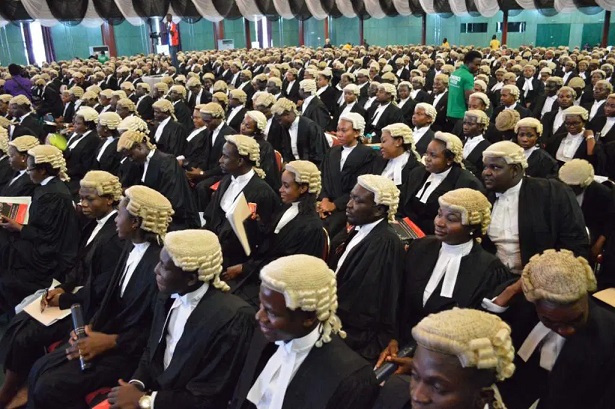
The Law Graduates Association of Nigeria (LAWGAN) has declared that the Economic and Financial Crimes Commission (EFCC) lacks general statutory powers to regulate, fix or determine the professional fees charged by legal practitioners.
CITY LAWYER recalls that the EFCC had called on legal practitioners in the country to desist from the “illegal and unethical practice of charging clients in foreign currencies,” warning that “the Commission would not hesitate to prosecute anyone found culpable.”
The call was made last Friday in Lagos by the Acting Zonal Director of the Lagos Zonal Directorate 2 of the EFCC, Bawa Usman Kaltungo, when he received a delegation of the Nigerian Bar Association, NBA, Lagos Branch Task Force on Illegal Practice of Law. The delegation was led by its Team Lead, Moshood Abiola, on a courtesy visit to his office.
LAWGAN, in a statement signed by its President, Kayode Bello, and Public Relations Officer, Ojo Clement, was reacting to the recent warning by the EFCC against lawyers charging clients in foreign currencies and the commission’s threat to prosecute practitioners found culpable.
The association acknowledged the statutory mandate of the anti-graft agency to investigate and prosecute economic and financial crimes but argued that such powers did not extend generally to the regulation of professional fees charged by lawyers.
It said the regulation of professional charges of legal practitioners was governed by the Legal Practitioners Act and the statutory framework established for that purpose, including the Legal Practitioners Remuneration Committee.
LAWGAN, however, challenged the EFCC to identify the specific statutory provision creating an offence of charging professional fees in foreign currency before threatening criminal prosecution on that basis.
“The fact that the Naira is Nigeria’s legal tender, without more, does not automatically establish criminal liability,” the association said.
It stressed that while lawyers were not above the law, law-enforcement agencies were equally bound by the law in the exercise of their investigative and prosecutorial powers.
“No lawyer is above the law, no law-enforcement agency is above the law either,” LAWGAN said, insisting that the exercise of investigative and prosecutorial powers must remain strictly within the limits of the law.
The association said it supported lawful collaboration between the EFCC, the Nigerian Bar Association (NBA) and other relevant institutions in combating genuine financial crimes and professional misconduct.
However, it maintained that such collaboration must be guided by due process, statutory authority and respect for the rule of law.
LAWGAN urged the EFCC to operate within its statutory mandate and provide the legal basis for its position on foreign-currency professional fees before seeking to criminally prosecute legal practitioners on that ground.
(C) CITY LAWYER Magazine. All rights reserved. To join our Channel, click here. Click here to join our WhatsApp chatroom. Contact us at citylawyermag@gmail.com or 081-3838-0083.
Leave a Reply
You must be logged in to post a comment.