

* AS NBA-SPIDEL HOLDS PRESS BRIEFING ON ANNUAL CONFERENCE
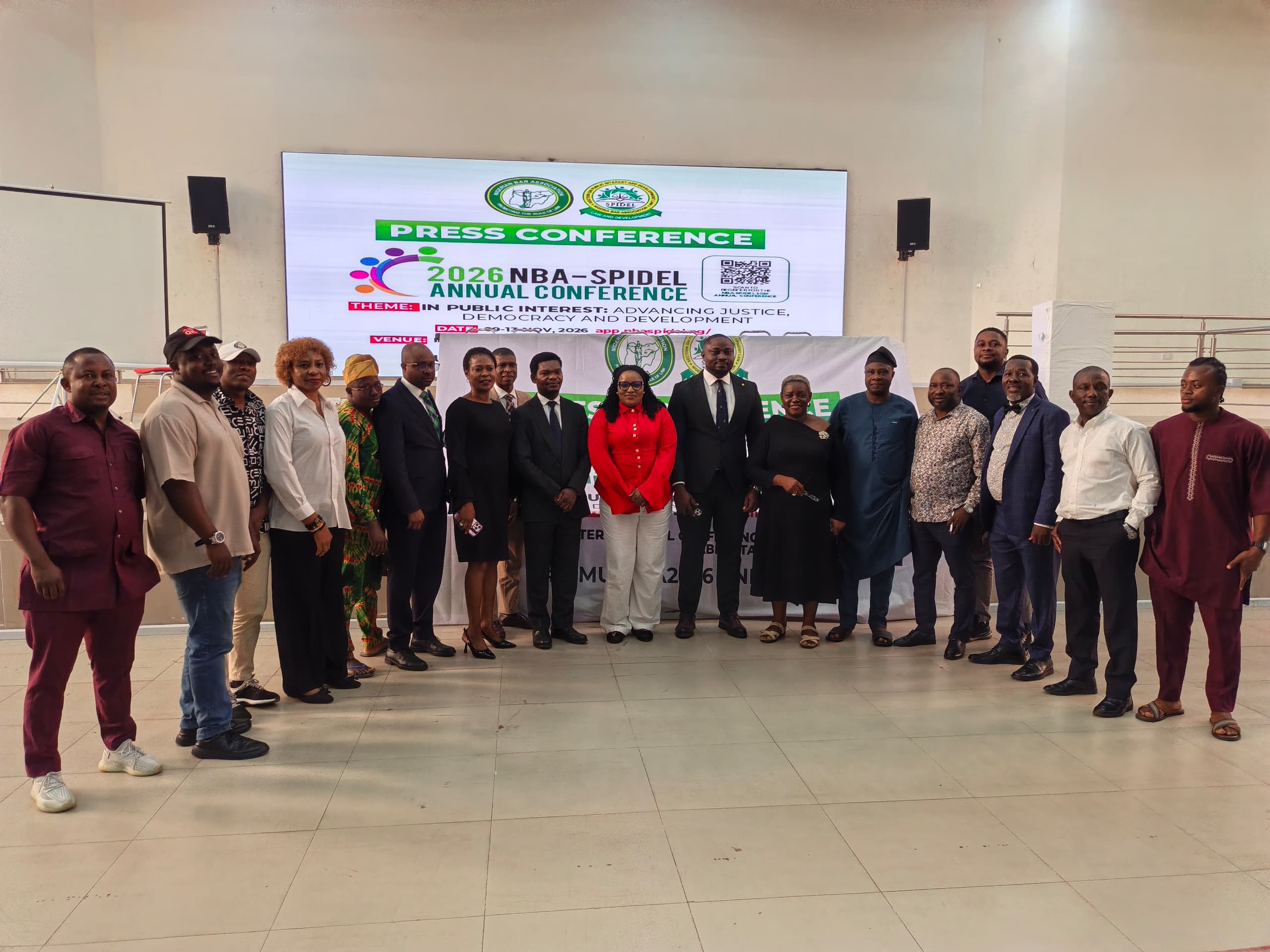
The Nigerian Bar Association Section on Public Interest and Development Law, NBA-SPIDEL, is preparing to bring lawyers, judges, policymakers, civil society actors, academics and other stakeholders together in Umuahia next month for a conference designed to confront some of the country’s most persistent justice and governance failures.
Announcing the 2026 Annual Conference at a press conference in Abuja on Monday, October 5, the Chair of NBA-SPIDEL, Associate Professor Uju Agomoh, said the gathering would not be another professional meeting where lawyers debate problems and return to their offices without a plan for what follows.
The four-day conference, scheduled for November 10 to 13 at the International Conference Centre, Umuahia, Abia State, will be held under the theme, “In Public Interest: Advancing Justice, Democracy and Development.” The Abia State Government is co-hosting the event.
Agomoh said the choice of theme reflects SPIDEL’s view that the legal profession cannot separate itself from the conditions under which Nigerians encounter the state, the courts, the police, correctional institutions and other public authorities.
“Law must serve the public interest,” she said, stressing that justice must be accessible, democratic institutions protected and development anchored in the rule of law.
The conference agenda is wide-ranging. It includes access to justice, public-interest litigation, constitutionalism, human rights, administration of justice, non-custodial measures, oversight of detention facilities, deaths in custody, policing and community safety, corruption, terrorism financing, legal aid, inclusion and the future of public-interest law in Nigeria.
The emphasis on detention and custodial justice is particularly significant.
NBA-SPIDEL has increasingly linked public-interest advocacy to conditions inside Nigeria’s justice and correctional systems. In 2025, the Section worked with the Nigerian Correctional Service on an intervention at the Medium Security Custodial Centre in Uyo, including a solar-powered borehole and clinic lighting, while also collecting data on inmates without legal representation.
Agomoh’s conference statement suggests that such concerns are now being placed within a broader programme of legal and institutional reform.
From the courtroom to the places where rights disappear
For millions of Nigerians, access to justice is determined long before a case reaches a courtroom.
It can depend on whether an arrested person gets a lawyer, how long an accused person remains in custody before trial, whether a family can afford legal representation, whether a court order is obeyed, whether a detention facility provides basic medical care and whether vulnerable citizens have the means to challenge abuses by public authorities.
SPIDEL intends to put those realities alongside the formal guarantees contained in the Constitution and other laws.
Agomoh said the conference would examine structural barriers to justice, including delays in the courts, inadequate legal representation, weaknesses in justice-sector institutions and the particular difficulties faced by vulnerable and marginalised Nigerians.
The Section is also expected to examine the continued use of non-custodial measures and the oversight of detention facilities, with particular attention to preventing avoidable deaths and abuses in custody.
The subject has become one of the more persistent concerns in Nigeria’s criminal justice system, where congestion, prolonged pre-trial detention and inadequate access to legal representation have continued to generate concern among lawyers and rights advocates.
SPIDEL’s own institutional programme has increasingly moved in that direction. In July, the Section inaugurated new statutory committees and task teams covering public-interest litigation, research and policy, detention monitoring, legal aid implementation, advocacy and law reform. The Research and Policy Committee, chaired by Folarin Aluko, SAN, was given a mandate to produce evidence-based research, policy briefs and law-reform proposals.
That development gives the Umuahia conference a potentially broader purpose: not merely identifying legal problems, but generating proposals that can be taken into policy, legislation and litigation.
Democracy beyond election day
The conference will also take the legal profession into the increasingly contested territory of democratic governance.
Agomoh argued that democracy cannot be reduced to periodic elections. It also depends on functioning institutions, accountability, transparency, independent oversight, constitutionalism and an informed citizenry.
That places lawyers in a role considerably larger than representing clients in individual disputes.
The legal profession routinely finds itself involved when electoral rules are challenged, public officials are accused of abusing power, citizens seek to enforce constitutional rights, or government institutions are called upon to account for public decisions.
With Nigeria already looking towards the 2027 general elections, those questions are likely to become even more prominent.
SPIDEL’s September engagement with NBA President Oyinkansola Badejo-Okusanya, SAN, also highlighted the Section’s wider public-interest agenda. At the meeting, Badejo-Okusanya backed the Section’s focus on detention, disability rights, children in conflict with the law and the treatment of lawyers by the police. She urged the Bar to translate concern over rights abuses into practical reforms.
The President is expected to attend the Umuahia conference with members of her executive committee.

Corruption, terrorism financing and the limits of state power
Another part of the conference agenda goes to the difficult intersection between national security and individual rights.
SPIDEL plans to examine corruption and illicit financial flows, including terrorism financing, while also considering how enforcement mechanisms can be strengthened without sacrificing due process and human rights.
That balance has become increasingly important as Nigerian authorities expand the legal and institutional tools available to investigate financial crimes, terrorism and other serious offences.
Public-interest lawyers face a difficult task in this area. The state must have effective powers to protect national security and public resources, but those powers are themselves subject to constitutional limitations.
For SPIDEL, the challenge is to ensure that the pursuit of security and accountability does not become a justification for weakening the safeguards that make criminal justice legitimate in the first place.
When development becomes a justice issue
The conference will also take the Bar beyond conventional discussions about courts and litigation into the relationship between law and development.
Agomoh argued that development cannot be measured solely by economic growth. Institutions, accountable government, access to justice and the rule of law determine whether citizens can actually benefit from development.
That approach fits the “development law” component of SPIDEL’s mandate.
Questions about infrastructure, public spending, environmental protection, land, public services and economic opportunity increasingly produce legal disputes because the distribution of public resources is inseparable from questions of rights and accountability.
Abia’s decision to co-host the conference also provides a local backdrop for that discussion.
The state has been undertaking justice-sector projects, including the construction and rehabilitation of court facilities and proposed reforms involving criminal justice and restorative justice. The state’s Attorney-General and Commissioner for Justice, Ikechukwu Uwanna, SAN, had earlier told the Local Organising Committee that 17 new court buildings were under construction and pointed to proposed amendments to the Administration of Criminal Justice Law and a Restorative Justice Law.
For a conference devoted to linking law with development, those reforms provide an opportunity to examine how justice-sector investment translates into practical access to justice.
Young lawyers and a changing Bar
Agomoh also placed young lawyers, women lawyers and lawyers with disabilities within the conference agenda.
The intention, she said, is to ensure that young lawyers are not merely recipients of the profession’s traditions but participants in determining its future.
The conference will therefore include mentoring, leadership development and professional networking, alongside conversations about public-interest advocacy and national development.
Inclusion will also be addressed, with particular attention to the participation of women lawyers, lawyers with disabilities and other groups whose voices are often under-represented in justice-sector decision-making.
That emphasis comes as the NBA itself enters a new leadership period under Badejo-Okusanya, the association’s first elected female President. SPIDEL has pledged to work with the national leadership as part of a broader “One NBA” approach.
From resolutions to results
Perhaps the most consequential promise contained in Agomoh’s statement is the insistence that the conference should not end with speeches and resolutions.
“We are not gathering in Umuahia merely to discuss problems,” she said. “We are gathering to identify solutions, responsibilities and pathways for action.”
That pledge goes to one of the enduring problems with professional conferences: the distance between compelling presentations and what happens afterwards.
SPIDEL is positioning the Umuahia meeting as a platform for partnerships involving the Bar and Bench, government institutions, justice-sector agencies, civil society, academia, development organisations, the media and citizens.
The Section’s own recent restructuring suggests an attempt to build some institutional machinery around that ambition. Its new committees include structures for research, policy development and law reform, indicating that the organisation is seeking to supplement advocacy and litigation with evidence-based policy work.
The conference will therefore be judged not simply by the number of lawyers in the hall or the prominence of its speakers, but by what survives after the delegates leave Umuahia.
A public-interest conference beyond lawyers
Agomoh’s invitation was deliberately broader than the legal profession.
She called on lawyers, members of the judiciary, policymakers, government institutions, civil society organisations, academics, development partners, journalists, young professionals and other Nigerians concerned about justice, democracy and development to participate.
That is consistent with SPIDEL’s own description of its mission as using law to protect citizens, challenge public power and strengthen accountability.
The conference organisers have said the gathering is expected to attract more than 2,000 lawyers and other participants. Early-bird registration, originally scheduled to close at the end of September, has been extended to October 14 following reported interest from prospective delegates.
Umuahia will therefore become, for four days in November, a meeting point for a profession being asked to look beyond its traditional courtroom responsibilities.
The issues on the agenda — deaths in custody, access to justice, corruption, terrorism financing, policing, democratic accountability, constitutionalism and development — are not abstract legal subjects for most Nigerians.
They determine whether a citizen arrested today sees a lawyer before being forgotten in detention; whether a poor litigant can obtain justice; whether public officials can be held accountable; whether constitutional rights mean anything outside the courtroom; and whether institutions answer to the people they were created to serve.
That is the public-interest test SPIDEL is taking to Umuahia.
(C) CITY LAWYER Magazine. All rights reserved. To join our Channel, click here. Click here to join our WhatsApp chatroom. Contact us at citylawyermag@gmail.com or 081-3838-0083.