
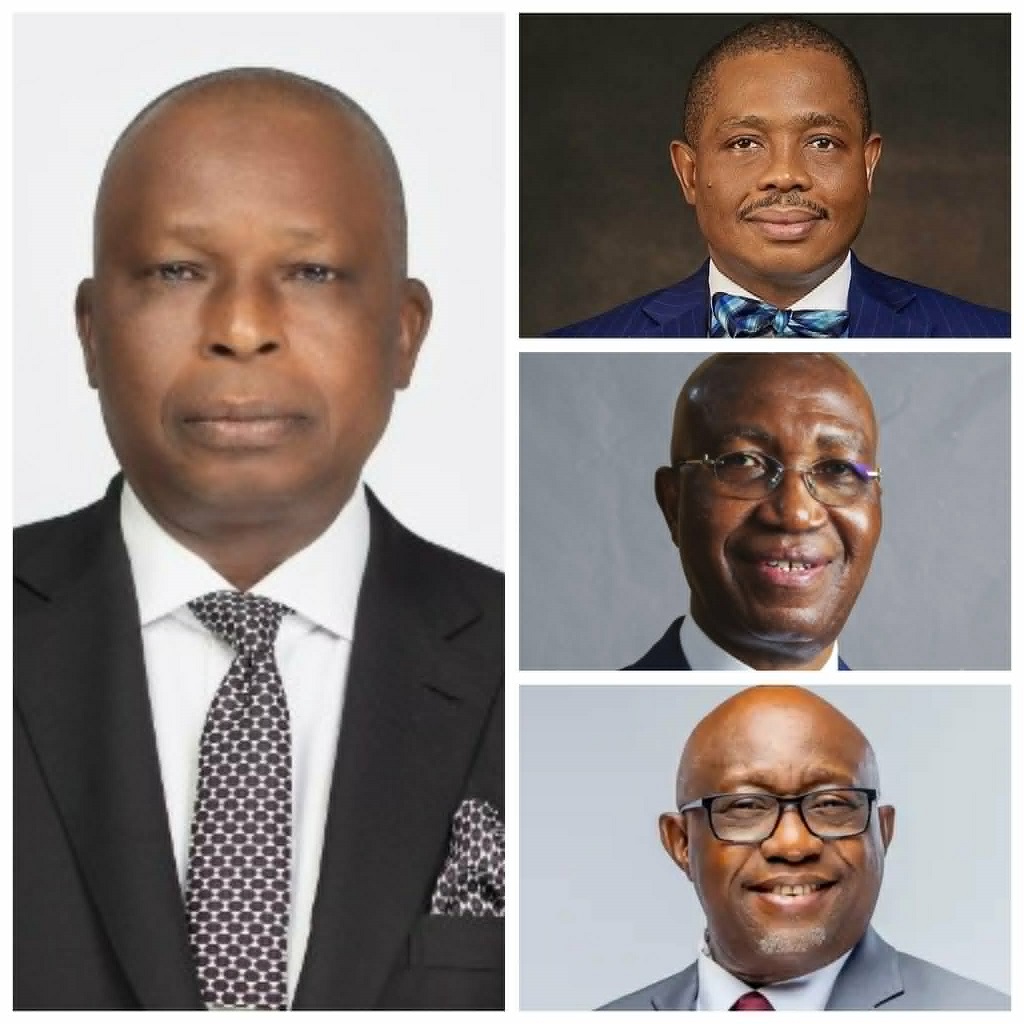
The Court of Appeal sitting in Ibadan has decided that the controversial “Directions” issued in respect of the forthcoming Nigerian Bar association (NBA) Elections has no legal footing to stand on.
In a certified copy of the judgement in an Appeal No. CA/IB/110/2026 filed by the Electoral Committee of the NBA (ECNBA) members against an injunction by a High Court sitting in Ibadan, the court held that no party in an appeal before the court has authority to issue “directives” (sic) in a pending appeal.
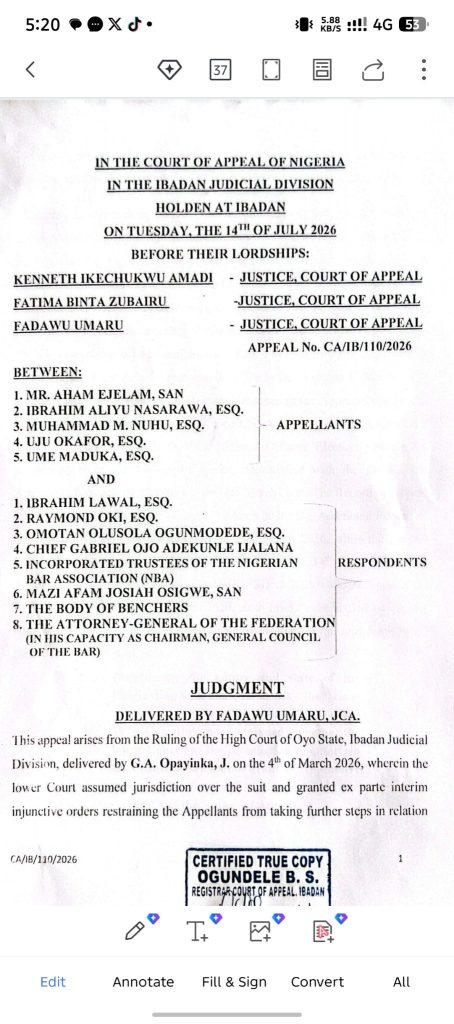
The appellants are MR. AHAM EJELAM, SAN; IBRAHIM ALIYU NASARAWA, ESQ.; MUHAMMAD M. NUHU, ESQ.; UJU OKAFOR, ESQ. and UME MADUKA, ESQ.
The respondents are IBRAHIM LAWAL, ESQ.; RAYMOND OKI, ESQ.; OMOTAN OLUSOLA OGUNMODEDE, ESQ.; CHIEF GABRIEL OJO ADEKUNLE IJALANA; INCORPORATED TRUSTEES OF THE NIGERIAN BAR ASSOCIATION (NBA); MAZI AFAM JOSIAH OSIGWE, SAN; THE BODY OF BENCHERS, and THE ATTORNEY-GENERAL OF THE FEDERATION (IN HIS CAPACITY AS CHAIRMAN, GENERAL COUNCIL OF THE BAR).

Delivering judgement in the appeal, Justice Fadawu Umaru held as follows: “Secondly, the Honourable Attorney-General of the Federation, who is the 8th Respondent in this appeal, filed a document described as a “Directive” in relation to the subject matter of this appeal. The propriety of such a process must first be examined.”
Continuing, Justice Umaru held that “The Honourable Attorney-General of the Federation is not before this Court as an independent constitutional authority exercising supervisory or administrative powers over the proceedings. Rather, he is a named party to the appeal and occupies the position of the 8th Respondent. Having submitted himself to the jurisdiction of the Court as a litigant, his rights, obligations and participation in these proceedings are governed entirely by the applicable Rules of Court and the general principles regulating adversarial litigation.
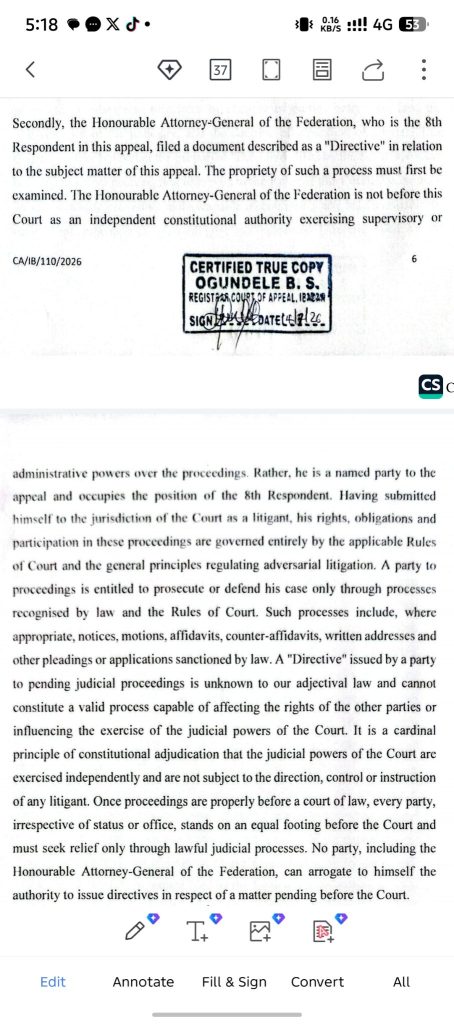
“A party to proceedings is entitled to prosecute or defend his case only through processes recognised by law and the Rules of Court. Such processes include, where appropriate, notices, motions, affidavits, counter-affidavits, written addresses and other pleadings or applications sanctioned by law.”
Discountenancing the Directions as filed by the Attorney-General, Justice Umaru held that a “Directive” issued by a party to pending judicial proceedings “is unknown to our adjectival law and cannot constitute a valid process capable of affecting the rights of the other parties or influencing the exercise of the judicial powers of the Court.”

Turning to the legal effect of the “Directions,” Justice Umaru indicated that judicial powers are exercised without subjection to any other authority, saying: “It is a cardinal principle of constitutional adjudication that the judicial powers of the Court are exercised independently and are not subject to the direction, control or instruction of any litigant. Once proceedings are properly before a court of law, every party, irrespective of status or office, stands on an equal footing before the Court and must seek relief only through lawful judicial processes. No party, including the Honourable Attorney-General of the Federation, can arrogate to himself the authority to issue directives in respect of a matter pending before the Court.”
It is unclear whether the appellants will head to the Supreme Court to challenge the judgment.
The court had overturned proceedings of the Oyo State High Court that restrained the Electoral Committee of the Nigerian Bar Association (ECNBA) from conducting the association’s 2026 national officers’ election.
Clearing the way for the ECNBA to proceed with the election as scheduled for Saturday, the appellate court held that the Oyo State High Court lacked jurisdiction to entertain the suit.
It consequently set aside the proceedings before the lower court, including the ex parte interim order that restrained the ECNBA from conducting the election.
The unanimous judgement granted the prayers in the appeal filed by the ECNBA members against the ruling of Judge G. A. Opayinka of the Oyo State High Court.
Justice Opayinka had granted an ex parte interim in March, restraining the ECNBA from carrying out activities relating to the 2026 NBA national officers’ election pending the hearing of a motion on notice. The order also restrained the NBA from supervising or participating in the electoral process.
The suit was filed by four lawyers, Ibrahim Lawal, Raymond Oki, Omotan Olusola Ogunmodede and Gabriel Ojo Adekunle Ijalana. They challenged the legitimacy of the electoral process and the composition of the ECNBA.
Dissatisfied with the ruling, the ECNBA appealed against it, arguing that the Oyo State High Court lacked the jurisdiction to hear the case.
The Court of Appeal held that the lower court lacked jurisdiction to entertain the suit and consequently set aside the entire proceedings, including the interim order that halted the electoral process.

Background
The judgement came days before the NBA’s national officers’ election scheduled for Saturday, 18 July.
Eligible members of the association will vote electronically to elect a new president and other national officers, as well as the NBA’s representatives to the General Council of the Bar. The suit is part of the broader issues in the lead-up to the elections.
The election has generated several legal disputes in recent months, including challenges to the composition of the ECNBA, the appointment of the election service provider and the conduct of the electoral process.
NBA had last week rejected the “directions” issued by the Attorney General of the Federation, Prince Lateef Fagbemi, SAN seeking to postpone the election.
The association said only its National Executive Council (NEC) has the constitutional authority to postpone the election. It also maintained that the ECNBA is an independent body established under the NBA Constitution to conduct the poll and insisted that the election would proceed as scheduled.
PREMIUM TIMES reports that in a bid to strengthen confidence in the election, the NBA invited international and domestic observer missions, including the European Union, the United States Embassy, the British High Commission, Yiaga Africa, the Transition Monitoring Group (TMG) and other election observers to monitor the poll.
According to the association, accredited observers will monitor the electronic voting process from the Central Election Control Room in Abuja.
The NBA said the observers’ presence would promote transparency, reinforce confidence in the credibility of the election and provide an independent assessment of the electoral process.
(C) CITY LAWYER Magazine. All rights reserved. To join our Channel, click here. Click here to join our WhatsApp chatroom. Contact us at citylawyermag@gmail.com or 081-3838-0083